


We Must Go Back to the Beginning. Most of our lives are spent absorbing information, adapting our beliefs, and molding ourselves to fit into civilization. We imagine experiencing autonomous lives as adults, free from the influence of others, only to find that we go from living under our parent’s strict rules to having a boss or partner telling us what to do. Society’s expectations also weigh heavily upon us.
But when do we truly begin to think for ourselves? How many of our choices are based on what is expected of us? And how can we break away from our programming? Many of us act based on contradicting beliefs we have accepted without question.
Over the past twelve months, I have made an effort to understand myself better. I have analyzed my choices and questioned whether any of them were made subconsciously out of fear or past conditioning. Growing up without my father around, I recently realized that I had a deep fear of abandonment. I held back a part of myself, afraid that the person I loved would not reciprocate my feelings. I became a people pleaser, unable to let go of destructive relationships.
One evening, a friend canceled plans hours after our scheduled meet-up time. I became extremely upset, and tears streamed down my cheeks. In that moment, a memory resurfaced of me sitting by a window, waiting for my father to pick me up, only to be disappointed when he never showed up. It was at that moment of introspection that I became aware of the impact my father’s absence had on me, and I was finally able to address and the wound he had created.
We carry open wounds caused by childhood traumas throughout our lives, but it is time for us to begin healing ourselves and stop accepting others’ opinions and actions as truth. Many believe that changing a habit is enough to change our conditioning, but this is not entirely true. It is akin to cleaning up a flooded room without locating the source of the leak. We can spend an eternity removing the water, but until we find and address the root cause, the flooding will not stop.
In “Recovery of Your Inner Child” by Lucia Capacchione is a highly regarded book that explores the concept of inner child recovery and healing through the use of creative techniques. Drawing on the author’s extensive experience as an art therapist, this book offers a unique and expressive approach to healing childhood wounds and reclaiming personal power.
Capacchione guides readers through a journey of self-discovery and healing, using art therapy exercises, journaling, and visualization techniques. By tapping into the creative process, individuals can access their inner child and begin the process of healing and transformation.
The book explains how childhood experiences can shape one’s beliefs, behaviors, and emotional patterns, often leading to self-limiting beliefs and unresolved emotional pain. Capacchione encourages readers to develop a compassionate and nurturing relationship with their inner child through various creative exercises, allowing for emotional expression, exploration, and healing.
Through the use of art materials, such as drawing, painting, and collage, readers are invited to give voice to their inner child’s experiences, desires, and emotions. Capacchione provides step-by-step instructions and prompts to guide readers in connecting with their inner child and uncovering deep-seated emotions that may have been repressed or ignored.
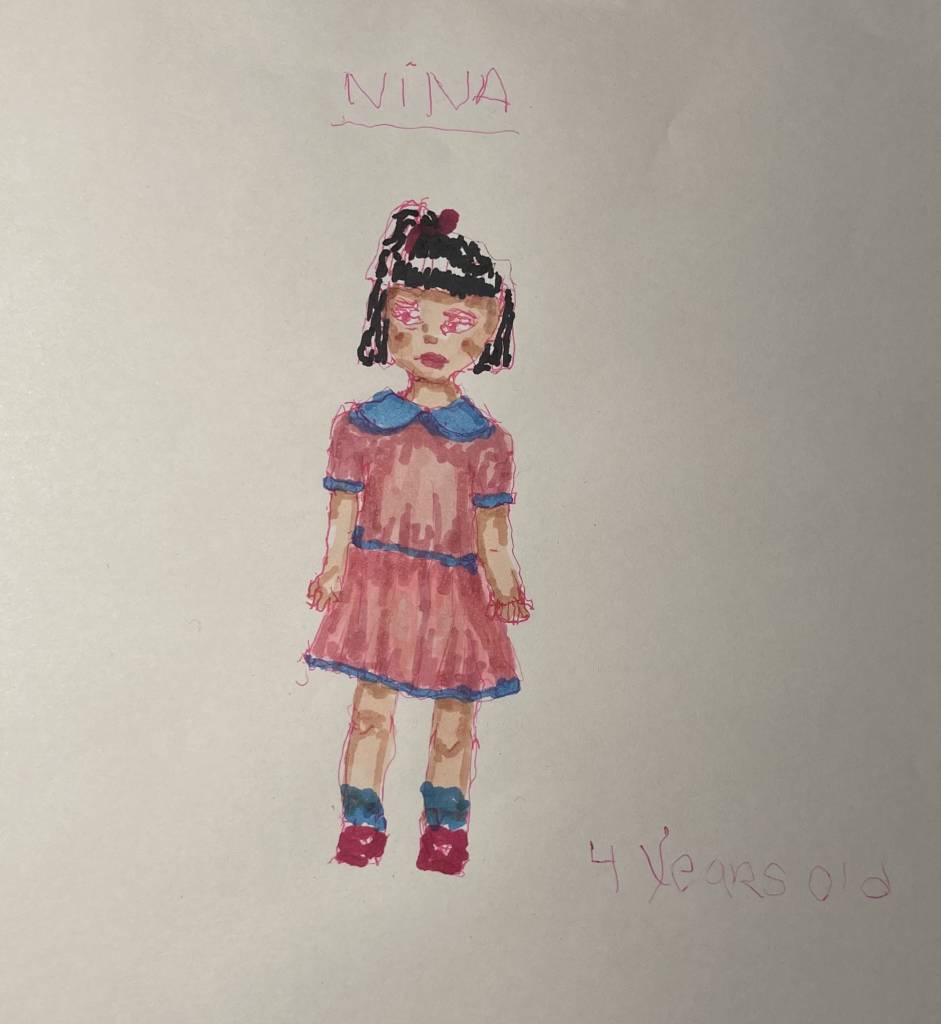
One exercise that deeply resonated with me is the “Meeting Your Inner Child” exercise, which encouraged us to connect with our inner child by drawing a picture using our non-dominant hand. This unique process unfolded slowly, without any preconceived notions or deliberate planning.
As I began drawing, a vivid image emerged before me—a small, four-year-old girl adorned in a delicate combination of pink and blue attire. Her eyes, brimming with profound sorrow, captivated my attention. Curiosity led me to inquire about her name, and with a tender voice, she whispered, “Nina.” Memories flooded back, as Nina was the endearing nickname of my childhood.
This powerful image unveiled a torrent of emotions that were intricately intertwined with my past. I recall a time overshadowed by sadness, a period marked by my parents’ separation, which left me feeling profoundly desolate and excluded. As the sole girl amidst my siblings, I often grappled with a palpable sense of isolation and longing for connection.
A surge of stifling constraint coursed through my being as I recollected the days when attending church became an all-encompassing routine, occupying my presence every single day of the week. The weight of these memories enveloped me, transporting me back to a time when my world felt constricted and confined.
In revisiting this poignant scene through my creative expression, I am afforded a unique opportunity for self-reflection and healing. Acknowledging the presence of young Nina, with her sorrowful eyes and the weight she carried, allows me to embrace the depth of my childhood experiences and the impact they have had on my journey.
As I unravel the layers of my past, I strive to extend compassion and understanding to both young Nina and my present self. By engaging in this process, I aspire to nurture the wounds that linger, transforming them into sources of strength and resilience. Through self-compassion, introspection, and the exploration of my inner child, I embark on a path of healing, gradually dismantling the restrictions that have hindered my growth.
The image of Nina, the embodiment of my younger self, serves as a catalyst for this transformative journey. As I delve deeper into the essence of who I once was, I am empowered to embrace my own authenticity and cultivate a sense of belonging that extends beyond the confines of past experiences.
In the realm of self-discovery, my creative expression becomes a sanctuary—a space where I can honor my inner child’s emotions, dreams, and desires. By nurturing the connection with Nina, I forge a path towards liberation, allowing my present self to flourish and manifest a life infused with joy, fulfillment, and an unwavering sense of belonging.
We are often imitators of the world around us. So, the next time you feel impatient or inadequate, try to remember the moment in your childhood when you were treated that way and work on healing that wound at its source. It is through this introspection and self-awareness that we can rewrite our narratives and break free from the limitations imposed upon us by our past conditioning.


5 Comments
Marc
Great read, stop the leak and stop letting things flood you
thinkingsubstance
great comment, how do we stop reacting from the world? is it through acceptance?
ปั้มไลค์
Like!! I blog quite often and I genuinely thank you for your information. The article has truly peaked my interest.
thinkingsubstance
Thank you for reading the post and sharing your thoughts. I am filled with contentment knowing this article spoke to you.
Cuba
There’s certainly a lot to find out about this issue. I love all the points you have made.